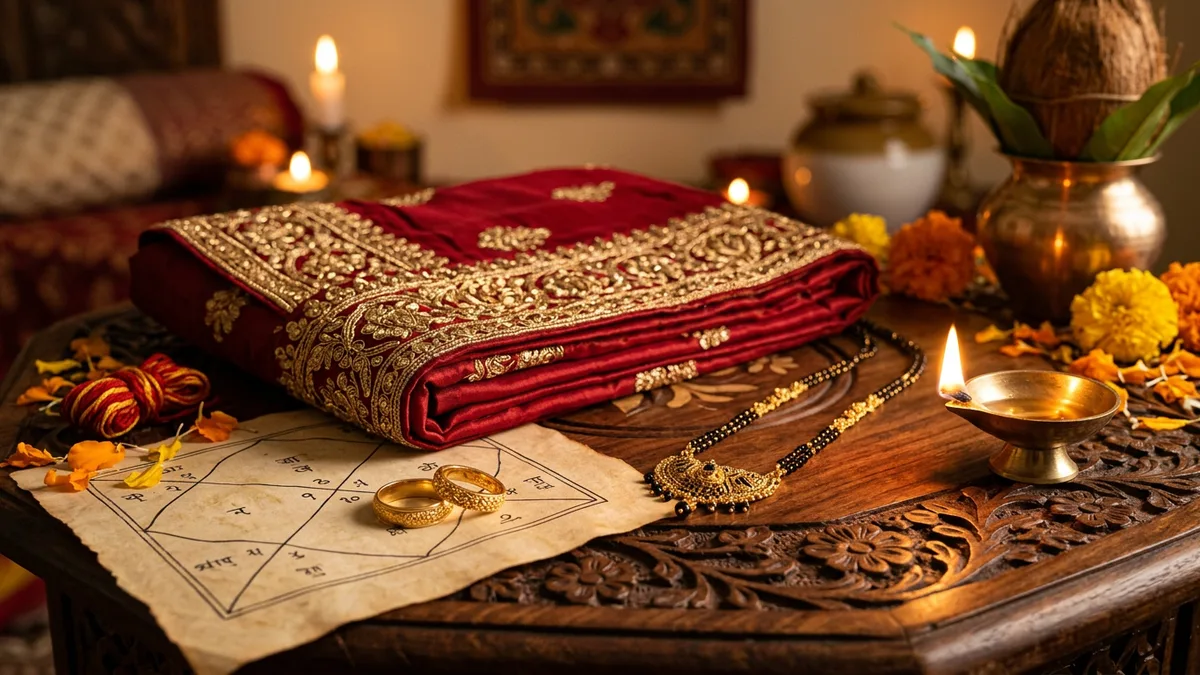
The 7th House — What It Actually Represents
In Vedic astrology, the 7th house is the Kalatra Bhava — literally the 'spouse house.' It is opposite the 1st house (which is you, your personality, and your self-expression). The 7th house is therefore what you attract in a partner, the nature of your committed relationships, and how you interact in long-term partnerships of all kinds.
The 7th house represents three things simultaneously: your spouse and the type of person you marry; the quality and nature of the marriage relationship itself (harmonious, difficult, transformative, karmic); and your approach to all significant partnerships — business partners, close collaborators, and legal agreements.
What makes the 7th house analysis complex is that it is never just the house itself. The sign on the 7th house cusp (the Descendant), any planets placed inside the 7th house, the position of the 7th lord (the planet that rules that sign), and the natural karaka Venus — all four layers must be read together for an accurate picture.
Pandit Sanjay Ji's 7th house analysis covers all four layers in the Rashi (birth) chart and then cross-checks with the Navamsha (D9) chart — the divisional chart specifically designed for marriage analysis. Often the two charts together reveal a very different and more nuanced picture than either alone.
7th House by Sign — What Each Sign Indicates
The sign on your 7th house cusp gives the first layer of information about your partner and marriage. Aries 7th house: dynamic, independent partner, energetic marriage but potential for conflict if both are dominant. Taurus 7th: stable, reliable, materially-oriented partner; marriage values security and comfort. Gemini 7th: communicative, intellectually stimulating partner; variety and mental connection important in marriage.
Cancer 7th house: emotionally nurturing partner, family-oriented marriage; strong mother influence on relationship choices. Leo 7th: partner with strong personality, desire for respect and recognition in marriage; dramatic highs and lows possible. Virgo 7th: practical, detail-oriented partner; service-oriented marriage with high standards that can become critical.
Libra 7th: partnership-oriented, aesthetic, diplomatic partner — this is actually the natural sign of the 7th house (Libra is Libra's own territory); generally favourable for balanced marriage. Scorpio 7th: intense, transformative partner; deep emotional bond but potential for power struggles. Sagittarius 7th: philosophical, adventurous, freedom-loving partner; marriage needs space and shared ideals.
Capricorn 7th: disciplined, ambitious, traditionally-minded partner; marriage may feel structured but is stable long-term. Aquarius 7th: unconventional, independent partner; non-traditional marriage arrangements possible, friendship is foundation. Pisces 7th: spiritually-oriented, empathetic but sometimes elusive partner; romantic but needs clarity in practical matters.
Planets in the 7th House — Impact on Marriage
Jupiter in 7th house: one of the best placements for marriage — wise, generous partner, generally harmonious marriage. Jupiter naturally aspects the 7th (its own aspect going back), creating a protective influence. Marriage tends to expand the native's life in positive directions.
Venus in 7th house: naturally strong — Venus is the karaka for marriage and is in its own domain here. Beautiful, harmonious partner; strong attraction in marriage; tendency towards a pleasurable, relationship-focused life. The marriage relationship matters deeply to this person.
Saturn in 7th house: delays marriage — but does not deny it. Saturn here often means marriage happens later in life (late 20s to 30s), and when it does, it tends to be stable and enduring. The partner may be older, more serious, or from a different background. Patience required; rewards are real.
Mars in 7th house: the Mangal Dosha configuration. Mars here brings energy, passion, and potential conflict into the marriage. Compatible with another Manglik chart (Mars in 1st, 4th, 7th, 8th, or 12th) — in this case, the energies balance. Otherwise remedies and conscious communication in marriage matter significantly.
Rahu in 7th house: unconventional partner, intense attraction, karmic connection. The marriage can be transformative but also unstable — especially in Rahu Mahadasha. Ketu in 7th: detachment from conventional marriage, spiritual bond with partner, potential for disconnection in practical aspects of relationship. Moon in 7th: emotionally sensitive partner, marriage with strong emotional fluctuations, the native deeply needs connection and can be dependent on the relationship.
The 7th Lord — Where It Is Placed Matters
The 7th lord (the planet that rules the sign on your 7th house cusp) tells you where the marriage energy is directed in your life. If the 7th lord is in the 1st house, marriage is central to your identity — your partner profoundly shapes who you are. If it is in the 10th house, career and social status are deeply connected to marriage — the partner may directly affect professional life.
7th lord in the 2nd house: marriage brings financial stability or the partner is family-oriented. 7th lord in the 4th house: home and domestic life are the foundation of the marriage — a deeply home-centred partnership. 7th lord in the 5th house: love marriage possibility, strong romantic and creative connection with spouse.
7th lord in the 6th, 8th, or 12th house (dusthanas / difficult houses): these placements require careful analysis. They do not mean no marriage or a failed marriage — but they indicate that the marriage path has specific challenges that need conscious navigation. 6th can bring health or conflict dynamics into marriage; 8th can bring transformation, intensity, and potential sudden changes; 12th can bring a spiritual or foreign element, or a sense of the partner being in a different world.
When the 7th lord is strong, well-placed, and unafflicted — even if the 7th house itself has some challenges — the overall marriage picture is substantially better. This is why complete analysis cannot stop at the 7th house alone.